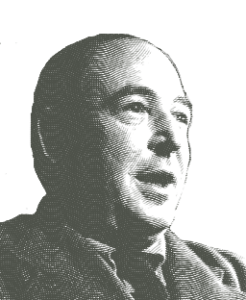
Dear Mr. Lewis,
Because I am writing this second letter to you at a magical time of year in December, I am compelled to explore ideas and inklings I have about the following dialogue you penned:
Mr. Tumnus: "It is winter in Narnia, and has been for ever so long... always winter, always winter, and never Christmas. Think of that!"
Lucy: "How awful!"
~ The Chronicles of Narnia: The Lion, the Witch, and the Wardrobe
Before I delve into the enchanting land of Narnia, perhaps you might be interested to know how I came to be writing letters to you in the first place.
Let me tell you the story. Like you, I know that our lives, from the broadest perspective, are wonderful journeys. Like you, I have often been inspired when on a journey. And I'm talking about a more mundane type of journey – about simple, boring, day-to-day transportation.
Yes, in your life, as is clear in your writings and in your life story, transportation seems to have had a profound effect on you. Perhaps that is because you spent so much of your time on mundane trips.
On a boat between England and Northern Ireland as you returned for visits home from your time in England. On the train between Oxford and London for your radio talks during the bombing of London in World War II. On a bus to everywhere in England. Even in the sidecar of your brother's motorcycle between home and the zoo on that pivotal September day in 1931 – on that ride to the zoo when you made a commitment to becoming a Christian at the age of 32.
Is that why you wrote so many stories involving buses, trains, and ships? Like the train rides and train stations in several of your Chronicles of Narnia books. Or the Narnian ship in The Voyage of the Dawn Treader. Or the spaceship in the first of your science fiction trilogy, Out of the Silent Planet. Even your allegorical tale centered on a bus ride from hell up to heaven in The Great Divorce.
For me, it is driving my car. It seems more than simple transportation. It is sort of a mystery, but there's something about the freedom to drive anywhere, whether it is a destination I have to get to, or places where I want to go for enjoyment. Maybe it's the sense of being in control. Maybe it's seeing scenes of life go by before my eyes. Driving seems to give me perspective on the world – and life. It clears my head. And fresh ideas often pop into my mind.
Such was a drive one Sunday afternoon in February 2019. And in fact, I just so happened to be on my own trip to a zoo – though not for an actual visit, but to pick up my daughter from her volunteer job there. Anyway, I had been reading a biography about you, and gotten to the story of the Inklings, that literary group with J.R.R. Tolkien and your other friends who met weekly to read and critique each other’s writings in the 1930's.
At the time, I had written several essays over a few years – essays about history and my favorite historical figures of the past. I found myself getting more and more envious of your joy-filled group, full of laughter and witty insights, I can just imagine. The name The Inklings was surely appropriate, quite ideal really. I yearned for my own tight-knit group of friends who would love to gather together to read and critique my essays, as my personal collaborators, if you will. People who would appreciate what I was trying to express and communicate. People who, without needing much explanation, would understand my writing.
Wanting to be understood? Then it hit me.
I remember the exact moment it happened. I was driving my car on a freeway heading west to the zoo. I realized that the people who could best understand my writing would be the very people I was writing about! So right then and there, I decided to switch from writing about them – and begin writing to them.
Since this epiphany, I have written a number of such letters. This is my 8th letter so far. I am writing to famous, legendary figures of ages past. I like to call them Letters to My Friends of the Ages. May I call you friend?
I thought you might be interested to know who these Friends are. In chronological order, they are John Adams, Abraham Lincoln, Ulysses S. Grant, you, Dietrich Bonhoeffer, and Martin Luther King, Jr. In the future, I plan to write to other Friends.
My hope for my Letters is to explore the experiences and adventures of these Friends as a way to shine light on things that truly matter. I like to think of myself as a Storyteller, Historian, and Philosopher on the human condition. For we all have a commonality in our lives – our aspirations, our dreams, our mortality, and our search for meaning. I am convinced that you and the rest of my Friends have much to teach my generation – your joys and struggles, your thoughts and feelings, your boldness and insecurities, your life questions and conclusions.
I believe that God has His hand on this endeavor. Many times, I have felt inspired, often while sitting in church. Maybe it is similar to how you got the idea for The Screwtape Letters when you were sitting in church on one Sunday in July 1940. Ultimately, I sense that this is my next calling.
And now that I have completed my rather long introductory tale, allow me to return to the snow-covered forest in Narnia, and to Mr. Tumnus and Lucy.
Always winter, and never Christmas. And Lucy exclaims, how awful! Awful, indeed. In your story, this awful situation was caused by, of course, the White Witch. But you had a larger point, I believe. And it is this: that Winter is actually a wonderful season. Beautiful and fresh. A snowy wonderland, filled with all sorts of fun activities, especially for children. In and of itself, winter is far from awful.
But it would be awful and gloomy if it were always winter – month after month, year after year, decade after decade, and perhaps century after century – with Spring never to come. It is the knowledge and anticipation of Spring that makes one appreciate a robust Winter. The melting of snow. Chirping of baby birds in their nests. Flower blossoms of red, yellow, blue – and every color in between. For without Spring, too much of a good thing, like Winter, would be difficult and trying. The birds of the air and the beasts of the ground are not meant for that. Neither are we humans.
And yet, even if Spring did come, life in Narnia would not be the magic it was meant to be without Christmas. On the surface, it would seem the unveiling of Spring is what would make life joyful for the Narnians. But the deeper message is that it was not Spring that the Narnians yearned for. It was Christmas that the Narnians truly wanted – and needed.
But what kind of Christmas? What is, after all, Christmas?
This is where you have gotten somewhat of a reputation, from some who have read not only your books, but read about your life. Knowledgeable people know you as a bit of a scrooge when it comes to Christmas. That you didn't like to celebrate Christmas. That you felt Christmas had become too commercialized, with its focus on gift-giving, and thus, gift-buying for the benefit of the shopkeepers, merchandisers, and businesses.
After all, in a short essay for which you gave the innocent, quite promising title, What Christmas Means to Me, you ended your essay, rather bluntly and anticlimactically, with this about Christmas: “Can it really be my duty to buy and receive masses of junk every winter just to help the shopkeepers? If the worst comes to worst I'd sooner give them money for nothing and write it off as a charity. For nothing? Why, better for nothing than for a nuisance.”
And perhaps, after years of battling with the commercialization of Christmas, you rebelled totally – with the result being that you could declare emphatically in a personal correspondence “I send no cards and give no presents except to children."
But truth be told, this bleak picture of Christmas was your third, and my least favorite definition of Christmas in that essay of yours. The second definition was a bit more pleasant – that it was "a popular holiday, an occasion for merry-making and hospitality." And you admitted that you did indeed very much approve of merry-making.
It was the first definition that I want to now focus on -- what you called a religious festival. And what did you mean by "festival"? Unfortunately, in your essay, you chose a mere one-sentence explanation that Christmas "is important and obligatory for Christians; but as it can be of no interest to anyone else, I shall naturally say no more about it here."
It is an understatement that this doesn't quite help the reader to understand what Christmas really means to you.
Fortunately, you did write and say more about this definition of Christmas in other places. Let me pick three of my favorites. First, in an interview you said, “The birth of Christ is the central event in the history of earth – the very thing the whole story has been about.” Second, in your book entitled Miracles, you wrote that “The central miracle asserted by Christians is the Incarnation. They say that God became Man. Every other miracle prepares for this, or exhibits this, or results from this.”
And third, a profound, longer reflection from Miracles on the Christmas truth:
"In the Christian story God descends to reascend. He comes down; down from the heights of absolute being into time and space, down into humanity; down further still, if embryologists are right, to recapitulate in the womb ancient and pre-human phases of life; down to the very roots and seabed of the Nature He has created. But He goes down to come up again and bring the whole ruined world up with Him."
I particularly like the part about God descending into time and space, descending into humanity.
Let's return to Narnia and the kind of Christmas the Narnians yearned for. It was so very long since Narnia had experienced Christmas. So much time had gone by. And there it is! The key element – time. The Narnians needed a breakthrough of time. A long, long time of walking in darkness, for those who dwelt in a land of deep darkness. And trudging along on the frozen ground of winter for a long time.
And then suddenly, Mr. Beaver declares the good news, as if a great light has dawned: Aslan is on the move – perhaps has already landed. It is this long-expected appearance of Aslan that brings excitement and anticipation throughout Narnia. And it is the anticipation of Christmas that is most meaningful to us. There is something marvelous about waiting in expectation. With a child's heart and mind.
When I began my letter, I used a dialogue about winter and Christmas from Mr. Tumnus and Lucy. Now, as I have come to the end of my letter, let me use another penetrating dialogue you wrote involving Narnia – about Christmas in Lucy's world. This one is from the seventh and concluding book, The Last Battle, about that mysterious stable of different places that seemed to be at the center of that tale:
Tirian: "It seems, then, that the Stable seen from within and the Stable seen from without are two different places."
Lord Digory: "Yes. Its inside is bigger than its outside."
Queen Lucy: "Yes, in our world too, a Stable once had something inside it that was bigger than our whole world."
Yes, some things are not in reality what they appear to be. To us, Christmas may appear to be a holiday celebrated in many places around the world. But from another perspective – a truer perspective – Christmas is the most profound event in the history of this earth. I agree with Queen Lucy – it is bigger than our whole world. Christmas is when God descended into time and space, to walk among us and, eventually, to bring us back to Him.
May we never lose the childlike wonder of it all.
Merry Christmas to you! I hope they still use this joyous and meaningful greeting in heaven.
Sincerely your friend,
Ted at Common Reason
Comments