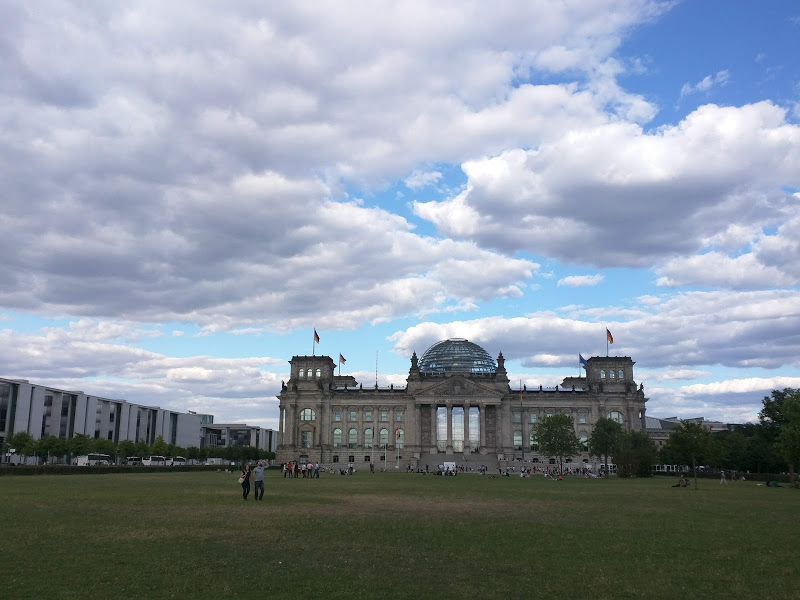
On this past 4th of July, I realized that I have spent the previous several 4th of July’s in very celebrative contexts.
In 2013, it was before the Capitol building on the National Mall in Washington, DC, with the grand concert, bands, singers, dancers, and, of course, the fireworks pageantry. In 2014, it was on the crowded streets of New York City, watching the fireworks over the East River and the Brooklyn Bridge, after being moved to tears at the 9/11 Memorial earlier that day. In 2015, it was the concert and fireworks at the Centennial Olympic Park in Atlanta, after having visited the Center for Civil and Human Rights museum (and yes, I confess, the World of Coca-Cola headquarters museum).
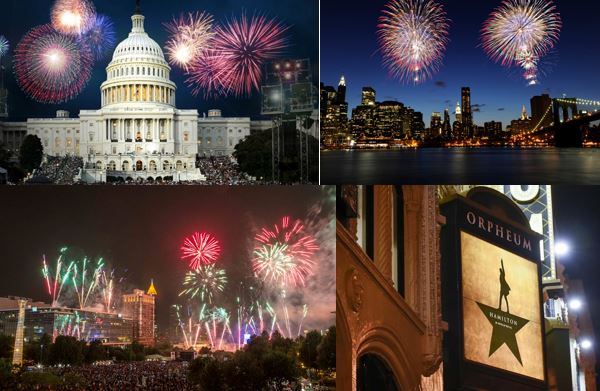
2016 and 2017 were comparatively quieter affairs, choosing to stay home in California for the 4th -- but the summer of 2017 was punctuated with a splash of patriotic flair by witnessing Hamilton: An American Musical, a visual and heart-stomping revolutionary masterpiece of theater.
This past 4th of July in 2018 was altogether different. I found myself in Berlin.
Berlin on the 4th of July. No fireworks. No bands. No celebrations. Unless you count the World Cup extravaganza party at the Brandenburg Gate. It was the last day of my two-week European trip. For my last day in Berlin, I made a last-minute change of plans -- instead of visiting the Pergamon Museum, one of the fabulous, artsy museums of Berlin, I chose instead to visit the German Historical Museum, a stone’s throw from Berlin’s Museum Island. The museum was a treasure-trove of fascinating and enlightening European history.
My visit started with an introductory, but comprehensive, video presentation of the story of Europe from the Middle Ages up to World War I and the Second German Empire. I took in the story of Charlemagne, of the Holy Roman Empire, of Luther’s Reformation, of the emperors down through the ages.
And then, lo and behold, who did I see on the screen, but none other than a portrait of George Washington?! And then in bold text, one landmark date in history -- July 4, 1776, followed by the self-evident truths embedded in America’s Declaration of Independence -- those famous words, the unalienable rights of life, liberty, and the pursuit of happiness. What were these familiar words doing in this video presentation in Berlin, in my history lesson of the German and European storyline?
The presentation soon explained it all, captured in one idea - liberty. The story went on to describe how the idea of freedom in America in the 1770’s and 1780’s crossed the Atlantic Ocean and took hold of Europe. American freedom was the forerunner to the French Revolution, which exploded in 1789. And the freedom fire spread across the continent. The French Revolution changed everything, not only in France, but life throughout the many European monarchies -- and ultimately, to the downfall of the Holy Roman Empire in Germany in 1806. Here, on my last day in Berlin, I thought I was going to receive a lesson in European history, which I did, but I did not expect American liberty -- and the power of that single idea - to make a conspicuous appearance on this 4th of July.
As I took in the rest of the informative museum, and the history of Germany through the present day, two powerful images captivated my attention. In the interest of time, I will describe one of them here. It was the Wall. The Berlin Wall. But I have to confess, even before this visit to Berlin, in my mind -- albeit naïve American mind, perhaps -- the Berlin Wall was the colossal symbol which most represented my preconceived images of Berlin. Yet that Wall had come down nearly 30 years ago. Which means, to many Berliners today, it is ancient history. I had not really realized that before. Nor did I think about the temporary nature of the Berlin Wall -- a brief 28-year era from 1961-89. It was built one day, and then it was torn down. Wasn’t this only a minor, temporary blip -- a fleeting moment -- in the more than one thousand years of German history?
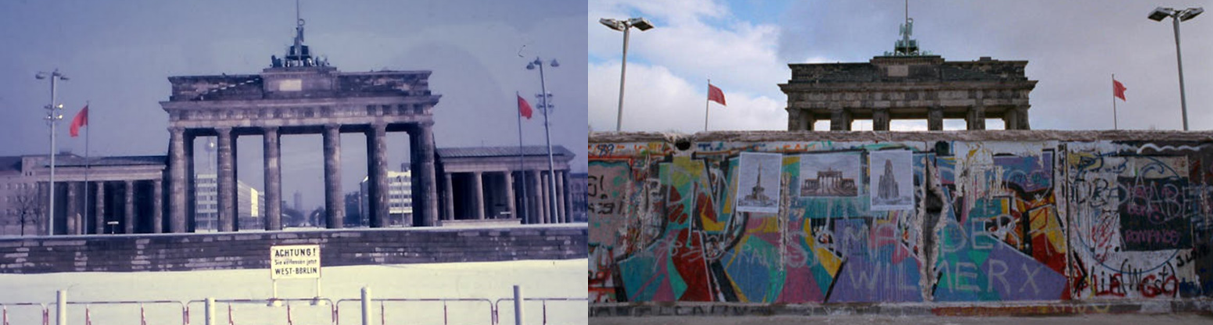
And then I realized a truth. It would be a mistake to equate the shortness of an era with that era’s historical significance. That perception of time is misleading. For those were 28 long years in which the people of Berlin experienced a vastly different world. It was their reality. It was a reality dominated by one, overarching, and concrete truth: a divided Berlin. East and West Berlin. In the midst of this reality, especially for the people of East Berlin, those 28 years were a lifetime of living. And it explains why the day the Berlin Wall began to be built -- August 13, 1961 -- was commonly called Barbed Wire Sunday. It started out as a wall of barbed wire, and then became a wall of concrete. And it explains why on the night of November 9, 1989 -- there was so much elation and mass celebration at the Wall and throughout the world, with live television images fixed in our collective memories. And that date quickly became the poignant demarcation of the passing of an old era to a new era in world history.

As I journeyed through the museum’s exhibits of that period, I wondered what was the ultimate lesson and message of the Berlin Wall. Several words jumped out at me. Freedom. Purpose. Direction. What was the Berlin Wall’s purpose? And what did the concept of direction have to do with it? The answer is this: the Berlin Wall was more than a concrete structure; it represented a direction. For the Wall’s raison d’etre (reason for being) was to prevent people from going in one direction, not both directions. For the Berlin Wall was not built to keep people out of East Berlin -- it was built to keep the people in. Fundamentally, it was built to take away the people’s freedom to leave. And if you don’t have the freedom to leave a place, they have a word for you -- prisoner.
In the decades before the Wall was built, East and West Berliners had the freedom to choose -- they could choose to live under the system in West Berlin, which was modeled after the democracy and free market capitalism of the United States. Or they could choose to live under the system in East Berlin, which was modeled after the communist and socialist economies offered by the Soviet system.
And Berliners, seeing for themselves, up close and personal, the differences and resulting life between East and West, they voted with their feet. They exercised their freedom to leave. From 1949 to 1961, about 3 million Germans escaped from the East to the West, representing about 20% of the population of East Germany. Soon the people leaving East Berlin became a fast-flowing river. So on the aforementioned day of August 13, 1961, the Soviets stopped the flow by closing the border just after midnight, and built their infamous wall.
Over the 28 years of the Berlin Wall’s existence, about 100,000 East Berliners attempted to escape over, under, and through the Wall. Fortunately, and perhaps surprisingly, 5,000 East Berliners succeeded in getting to the West despite the Berlin Wall, aided no doubt by the fact that 600 border guards did the same. But about 200 East Berliners were killed trying to escape. Of course, no one died trying to escape West Berlin. These actions of the German people of Berlin provide a historical picture of reality of this era.
The Berlin Wall is a perfect counterpoint to the Declaration of Independence. The Berlin Wall served as more than a temporary monument to the failures of Soviet communism and their socialist empire. It was and is a lasting testimony to the lives and choices exercised by East Berliners. A lasting testimony to those 100,000 East Berliners who attempted to escape the East. For fundamentally, if you think about it, the right and freedom to leave a place is encompassed in the right to the pursuit of happiness. So in my lesson of surprise that day, Berlin turned out to be an ideal place for me to celebrate the 4th of July. Maybe not in the same exuberant manner as I was accustomed. But in a fresh way, the Berlin Wall to this day reaffirms the self-evident truth of the natural state of man -- which is freedom. It was a fabulous, meaningful 4th of July in Berlin for this American.
I wonder where I’ll be on the 4th of July next year.
Alright fellas, gachoic1 is the place to be! Been following them for a while now and always get my fix of intense cockfighting action. Easy to navigate and always up-to-date. Check it out gachoic1.
Sportingbetentrar… if you’re into sports betting, this is a solid option. Good odds, easy to place bets. Check them out for your next wager: sportingbetentrar
Alright, giving 555taya a spin! Hope its as great as everyone says! Playing some slots and card games. Find more at 555taya
Looking for some new games and found gamespk. Lots of options to choose from, pretty good resource. Have a look: gamespk
Needed a new app and stumbled onto 9sappdownload. Easy to find what I wanted and the download was fast. Score! Get it at 9sappdownload.
9sapp! Found some cool apps here that I hadn’t seen anywhere else. Definitely worth checking out if you’re looking for something new. Browse 9sapp.
Installed the xs66app the other day. It’s pretty slick! Easy to use and the games load fast. Plus, they’ve got some cool promotions going on. Give it a go! That is located at xs66app.
Yo, been playing on IP88okvip lately and it ain’t bad, ya know? Quick payouts and a decent selection. Check it out ip88okvip.
Jljl1link is alright, nothing crazy but it gets the job done. If you need a quick fix check this jljl1link.